Why a Garden Path Changes the Visit
A garden path changes the visit by setting its pace and order, helping you notice where to pause and what each turn brings into view.
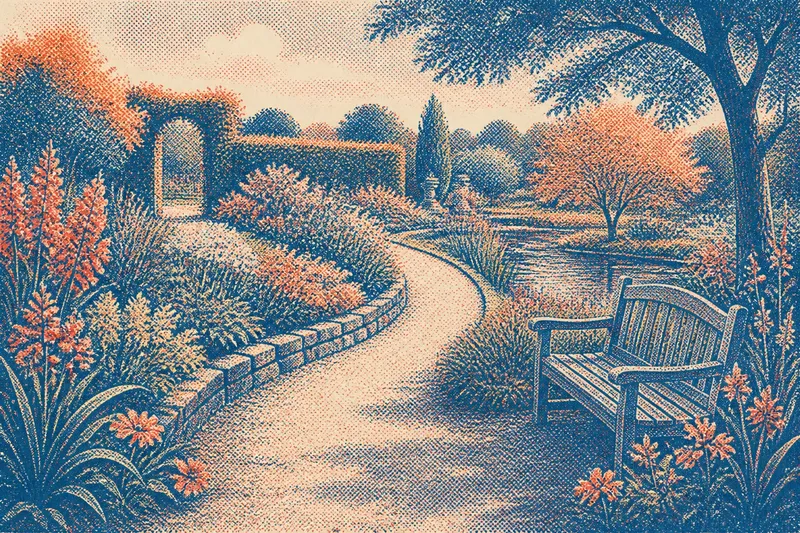
Why does a garden path change the visit? A garden path changes the visit by deciding, quietly, where you walk, what you see first, and where you might stop. On a garden visit, that route can turn a collection of beds into a sequence of small discoveries—or make the whole place feel like a corridor with flowers beside it.
The path is not just a way to keep shoes clean. Its width, surface, bends, and junctions offer cues about pace and attention. Follow those cues deliberately and you can read how a garden wants to be encountered, without treating every corner as a destination that must be reached.
How paths set pace
A garden path sets the pace through the room it gives you to walk, the ease of its surface, and how clearly it shows what comes next. A broad, straight route usually invites a steady stride and a view ahead. A narrow path that curves behind shrubs tends to slow you, partly because the next scene is withheld and partly because passing another visitor takes a little courtesy.
Surface matters, too. Firm gravel, brick, and smooth stone usually let people keep moving without concentrating on every footfall. Loose gravel, uneven flagstones, and grass ask for more attention to footing. The change can be a useful reminder to slow down, though it is not automatically an invitation to stop in the middle of the route.
Notice how your pace changes at transitions. A path that narrows near a border may bring you closer to foliage; a wider stretch beside a lawn can let your gaze travel farther. The garden has not issued instructions, but it has arranged a persuasive set of hints.
What bends reveal
At a bend, notice what disappears, what remains visible, and what the turn reveals. A curve can conceal a seat, a fountain, a framed view, or simply another planting bed. That partial concealment gives the next stretch a sense of arrival. A straight path may reveal its destination early, which can be satisfying in its own quieter way.
Look beyond the center of the view. A tree trunk, clipped hedge, gate, or wall may frame the scene and guide your eye toward a feature you would otherwise pass. Near a bend, the planting often changes in height or texture, marking a transition without a signboard. The path makes that change legible by giving you a particular angle from which to see it.
If a turn opens onto a broad view, pause where the path widens or beside a seat rather than blocking the narrowest point. That leaves room for others and gives you time to take in the view from the position the garden has made available. It is a modest arrangement, but gardens are full of modest arrangements.
Where pauses fit
A garden invites a pause where the route offers a place to stop without interrupting it. Look for a bench, a widened edge, a low wall intended for sitting, or a clear space beside—not in—the path. These spots often face a particular feature: a pond, a border, a long view, or a contrast between light and shade.
Not every attractive view comes with a seat. You can still stop briefly at a broad junction or an open edge, provided you leave a clear passage. A narrow bridge, entrance, or pinch point is a poor place for lingering, however appealing the water below it may be. The path carries visitors as well as attention.
Say you enter a garden by a broad gravel walk and reach a narrower bend beside a mixed border. You pause at a bench just beyond the turn; from there, a small pond comes into view through the leaves. The expected result is a visit organized around that newly revealed scene, rather than a quick walk past it. This is an invented situation, not a report of an actual visit.
Choosing a route
Follow a marked route when you want a clear sequence, when a garden asks visitors to keep to designated paths, or when you have limited time. A suggested circuit can lead through distinct areas in an order that makes sense: perhaps from formal beds to a wooded section, then back toward the entrance. It can also keep foot traffic away from delicate planting.
Leaving the marked route is appropriate only where the garden permits it. A side path may be a public invitation, while a strip of lawn beside a border may not be. Look for signs, gates, ropes, and the way other visitors are moving. If access rules are unclear, ask a staff member rather than treating a gap in a hedge as a personal invitation.
When several paths meet, choose based on the kind of visit you want. A loop suits someone who wants a sense of progression and an easy return. A branching network offers more choice, but can make it harder to know what you have missed. A single path that leads out and back is simple to follow and lets you see familiar views from a different direction on the return.
Reading garden rooms
Read the path as a sequence of thresholds. A change from stone to gravel, a doorway in a hedge, or a short passage beneath trees can mark the move from one garden room to another. The planting on each side may shift with it: from clipped shapes to loose flowers, or from sunlit beds to shade-loving foliage.
Pay attention to how much of the garden is visible at once. An open layout lets you compare several features from a single vantage point. Enclosed paths reveal views gradually, placing more weight on turns, framed openings, and the spaces between destinations. Neither arrangement is inherently better; they offer different kinds of attention.
It can help to look back occasionally. A fountain that seemed ordinary from the entrance may become the center of a view framed by a hedge on your return. Looking back also clarifies how the route connects its parts. A brief glance is enough to show how distance and direction alter a scene.
When the route confuses?
What should you do at a confusing fork?
Stop somewhere clear and look for a map board, a named garden area, or the path you just used. If those cues do not settle the choice, check a posted map or ask a staff member rather than assuming the widest path returns to the entrance.
How can you remember where you are?
Note a distinctive landmark as you pass it, such as a gate, pond, or stand of trees. A phone map can help where the garden provides one; a printed visitor map is useful when reception is poor or you would rather leave the screen in your pocket.
What if you need a smoother route?
Check the garden’s accessibility information before setting out, paying attention to surface, slope, steps, and path width. The garden’s own visitor information is the best place to confirm which routes suit your needs; ask staff if the details are unclear.
Why does the return view change?
Your direction changes which plants frame a scene and how the path leads your eye. A feature that was ahead of you may now sit behind a border, gate, or tree, giving the return route a different composition.
Noticing more on foot
A garden path changes the visit by making some views immediate, others gradual, and a few easy to miss unless you slow down. Watch for bends, thresholds, changes in surface, and places set aside for stopping. Those details tell you how one part of the garden leads into the next.
On your next garden path, pick one junction and notice which way the route seems to favor: toward a view, a seat, or another garden room. Follow that cue, then look back once before moving on. You will leave with a clearer sense not only of what the garden contains, but of how its route arranged your attention.