The Overplanned Afternoon
The overplanned afternoon can leave little room for country pleasures. Set a clear boundary, choose a route with options, and make changing plans simple.
How do you keep a country afternoon from turning into a timetable? Start with a route that has choices along the way, rather than a list of attractions to complete. The overplanned afternoon often leaves its best moments waiting politely behind the next departure time.
Instead of making one destination the day’s purpose, decide what kind of outing suits the time and conditions: a circular walk, a village wander, or a drive with room to stop. Then set a clear point at which you can turn back or head home. That boundary makes the outing easier to adjust without treating every change as a failure.
Choose a Route Shape
A circular walk gives the afternoon a natural finish, while a route out and back lets you turn around whenever the distance feels right. A village wander is less linear: you can browse a bookshop, pause at a churchyard, or skip both and return to the car. Pick the shape that fits your transport, energy, and interest.
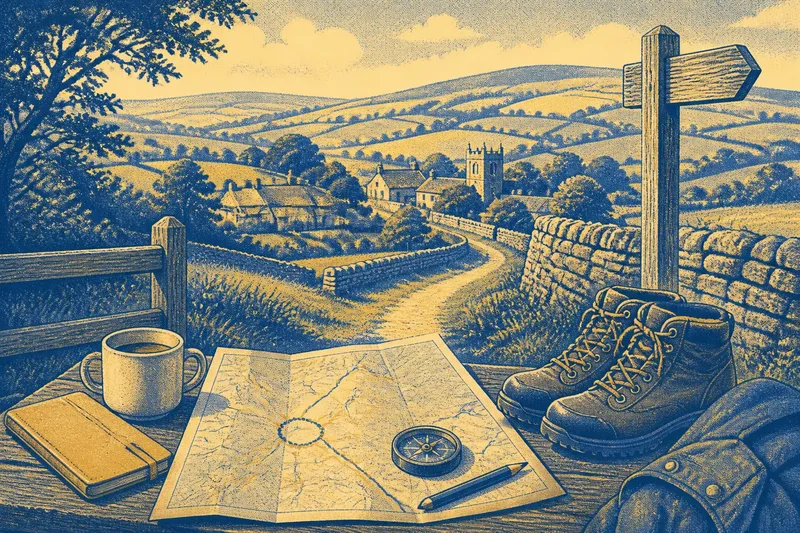
For walking, check a paper Ordnance Survey map or the relevant route on OS Maps before setting off. Note a sensible turning point and any paths that could provide a shorter return. If the map shows no easy alternative, treat the planned route as a firmer commitment and avoid adding another stop.
Set a Return Boundary
A boundary is a decision, not a deadline for every part of the outing. It might be the time you need to leave to catch a bus, the point where you turn back, or a condition such as “head home if the rain becomes persistent.” Put that limit in your phone or on a paper note, then leave the rest of the afternoon open.
Before leaving, check the details that can genuinely change the plan: opening hours, bus times, parking arrangements, and the forecast. The National Rail and local bus operator apps can help with public transport; a downloaded map is useful where mobile reception is uncertain. If a practical detail rules out the intended route, choose a nearby alternative or shorten the outing.
Keep Options Nearby
Choose alternatives that do not require a second journey. A village café, a sheltered path, a farm shop, or a direct route back to the station can each serve a different purpose. Keep them as options, not obligations, and check access or opening details if reaching one depends on them.
Use this quick decision list before you leave:
- Check the forecast; if heavy rain or strong wind makes the exposed route unpleasant, choose a sheltered walk or a village visit instead.
- Check the map for a shorter return; if one is marked, note where it branches off, and if none is available, keep the outing close to the start.
- Check the last suitable bus or train; if there is little flexibility, plan around that departure, and if there are several options, keep the return less fixed.
- Check whether the café or shop is open; if it is, keep it as an optional stop, and if it is closed, bring a snack or skip the stop.
- Check mobile coverage or download the map; if reception may be weak, save the route offline, and if it is reliable, keep the map available on your phone.
- Check your footwear and clothing against the path; if they suit the ground and weather, continue with the route, and if they do not, choose easier paths or a shorter village outing.
How Should Plans Change?
What if the weather turns?
Check the latest forecast before setting out and pay attention to conditions during the walk. If rain or wind makes the route uncomfortable, take the marked shorter return or choose a sheltered stop; if conditions remain manageable, continue without adding extra ground.
How do I avoid missing transport?
Look up the relevant bus or train times before leaving and note the departure you intend to catch. If a delay would leave no reasonable alternative, turn back early; if there are later services, you have more room to linger.
What should I do if a place is closed?
Keep a nearby alternative in mind, such as a public footpath or another place with confirmed opening information. If the closure removes the main reason for the outing, shorten the trip rather than driving across the area to fill the gap.
How many stops should I plan?
Choose one main route or destination, then leave optional stops unbooked unless a reservation matters. If the outing still sounds worthwhile without the extras, the plan is not relying on a chain of perfect timings.
A Worked Route Choice
Say you have a free afternoon, a car, and a paper map showing a village loop with a shorter path back to the car park. You check the forecast, confirm that the village café is open, and see that the walk crosses an exposed stretch. Your starting inputs are the available time, the route options, the forecast, and the café’s opening information—not a fixed tally of places to visit.
You choose the village loop as the main outing and mark the shorter path as the return option. If the exposed stretch feels unpleasant, you take that path back; if conditions are comfortable, you complete the loop and decide afterward whether you want the café. The result is a clear route with an observable choice point, and the tradeoff is that you may skip part of the walk rather than press on to preserve the original plan.
Leave Space for Change
Once you have checked transport, access, and the route, stop revisiting the plan unless something changes. Keep a map handy, but there is little value in checking the clock at every bend when your return boundary is already clear. A note of a lane or landmark can help you remember a place without turning the walk into a documentation project.
The overplanned afternoon becomes easier to avoid when the route has a sensible way back and the optional stops stay optional. Decide what would make you turn around, then let the country day take the shape the conditions allow. If you reach home with one unvisited path still on the map, it has done no harm by waiting.