When the Country Fair Became a Day Out
When the country fair became a day out, its agricultural roots met public amusements. Learn what changed and how to read the fairground today.
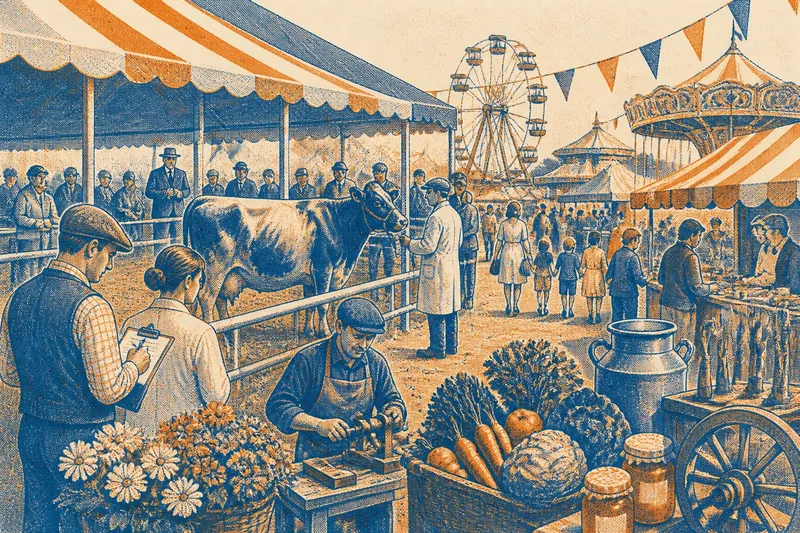
When did the country fair become a day out rather than a place to conduct business? The short answer is that there was no single turning point: fairs changed at different times and in different places, as their purposes and programs shifted.
Fairs before leisure
In medieval England, chartered fairs were important commercial occasions, often tied to particular dates and places. Merchants could bring goods to sell, and visitors might travel from beyond the immediate area. These events were not simply the agricultural shows familiar today, and their histories varied from town to town.
Later, agricultural societies organized exhibitions that put livestock, farm products and equipment on display. Britain’s Royal Agricultural Society held its first show in 1839, helping establish a model for public agricultural exhibitions. In the United States, agricultural fairs also developed in the nineteenth century, with local organizations presenting livestock, produce and practical skills.
That history does not support a neat story in which commerce ended and entertainment took over. Agricultural displays could be educational, competitive and enjoyable at once; commercial fairs could include diversions. The day-out character grew by addition, not by a clean handover.
Exhibitions and amusements
Livestock classes, produce tables and demonstrations gave visitors something to inspect, compare and discuss. They also made farming and craft visible to people who might not do that work themselves. An exhibit could be useful information, local pride and a spectacle, all without changing its subject.
Amusements broadened the appeal. Music, rides, games and food stalls could draw visitors who had no business to conduct or interest in judging animals. Their presence helped turn a visit into an outing, while agricultural exhibits remained part of the program.
Which attractions appeared depended on the place and organizer. Some fairs emphasized farm skills and livestock; others made more room for crafts, food or entertainment. There is no single fairground template hiding behind the history.
Why did fairs change?
When did fairs become day outings?
There was no universal date. Agricultural exhibitions and amusements expanded in different periods and places, so a fair’s shift toward leisure is best understood as gradual and local.
What distinguished an agricultural show?
Its central purpose was to exhibit and compare agricultural work, including livestock, produce and equipment. That did not prevent visitors from treating the occasion as entertainment.
Did amusements replace trade?
No single pattern applies everywhere, but leisure attractions generally added another reason to attend rather than erasing every practical purpose. The balance differed from fair to fair.
What can a fair preserve today?
A modern event can keep agricultural displays, local crafts or demonstrations in view while also offering food and entertainment. The precise mix is a choice, not proof that every fair follows the same historical path.
Reading a fairground
It helps to treat the fair as a set of different activities rather than one continuous market. A livestock tent invites closer inspection; a craft stall is arranged for browsing; a demonstration has its own pace. The layout can tell you what the organizers want visitors to notice.
- Observe whether livestock classes or animal displays occupy a prominent area; if they do, spend time there for the agricultural focus, and if they do not, look for produce or craft exhibits instead.
- Observe whether demonstrations are listed on the program; if a subject interests you, check its time and location, and if the schedule does not suit, browse the related exhibit at your own pace.
- Observe whether food stalls form a separate cluster; if they do, use that area as a break between exhibits, and if they do not, choose a convenient quieter spot before eating.
- Observe whether rides or games dominate the central route; if they do, take a quieter path around the edge for displays, and if they do not, follow the main route without expecting a midway.
- Observe whether craft vendors show how an item is made; if a demonstration is underway, pause to watch, and if goods are only displayed, browse without assuming a live presentation is part of the fair.
- Observe whether the program marks a performance or judging session; if one appeals, arrive before it begins, and if the timing is inconvenient, choose another listed activity rather than waiting without a plan.
A visit with different interests
Say you arrive at a small county fair with a friend interested in livestock and another who wants food stalls. You check the printed program, see that a judging session is underway and go together to the animal tent; afterward, one friend browses nearby craft stalls while the other gets food. The program lists a music performance later, so you meet there at its posted start. The result is a visit that includes each person’s priority, with the tradeoff that nobody sees every exhibit.
That is a useful way to read the event’s history, too. A fair can include practical displays, commerce and leisure without making one the explanation for all the others. The country fair became a day out through changes that differed by place, and its present-day layout often shows which parts of that layered past its organizers have chosen to keep visible.